ON THE NUMBER OF 1'S PER CYCLE OF
A BINARY RANDOM MULTICYCLIC SEQUENCE
A BINARY RANDOM MULTICYCLIC SEQUENCE
Abstract
A binary random multicyclic sequence is determined by a Boolean function of variables and independent binary random cyclic sequences with period lengths
 . We obtain the limit distribution of the number of
  's per cycle of a multicyclic sequence in the case when the numbers
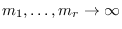 and the number of 's for each sequence has its own limit distribution.
Citation details of the article
Journal: International Journal of Applied Mathematics Journal ISSN (Print): ISSN 1311-1728
Journal ISSN (Electronic): ISSN 1314-8060
Volume: 32 Issue: 5 Year: 2019 DOI: 10.12732/ijam.v32i5.10
Download Section
Download the full text of article from here.
You will need Adobe Acrobat reader. For more information and free download of the reader, please follow this link.
References
- [1] I.B. Bilyak, O.V. Kamlovskii, Frequency characteristics of cycles in output sequences generated by combining generators over the field of two elements, Prikl. Diskr. Mat., 3, No 29 (2015), 17–31 (in Russian).
- [2] O.V. Kamlovskii, Occurrence numbers for vectors in cycles of output sequences of binary combining generators, Probl. Inf. Trans., 53, No 1 (2017), 84–91.
- [3] V.M. Fomichev, On periods of complicated sequences, Mat. Vopr. Kibern., 13 (2004), 37–40 (in Russian).
- [4] P. Pohl, Description of MCV, a pseudo-random number generator, Scand. Actuar. J., 1 (1976), 1–14.
- [5] N.M. Mezhennaya, V.G. Mikhailov, On the distribution of the number of ones in the output sequence of the MCV-generator over GF(2), Mat. Vopr. Kriptogr., 4, No 4 (2013), 95–107 (in Russian).
- [6] N.M. Mezhennaya, V.G. Mikhailov, On the number of ones in outcome sequence of extended Pohl generator, Discrete Math. Appl., 31, No 1 (2019), 111–124 (in Russian).
- [7] N.M. Mezhennaya, V.G. Mikhailov, On the number of ones in the cycle of multicyclic sequence determined by Boolean function, Sib. Electr. Math. Reports, 16 (2019), 229–235.
- [8] O.V. Kamlovskii, Distribution properties of sequences produced by filtering generators, Prikl. Diskr. Mat., 3(21) (2013), 11-25 (in Russian).
- [9] Z.D. Dai, X.N. Feng, M.L. Liu, Z.X. Wan, Some statistical properties of feedforward sequences (I), Science in China (Ser. A), 37, No 1 (1994), 34–41.
- [10] Z.D. Dai, X.N. Feng, M.L. Liu, Z.X. Wan, Some statistical properties of feedforward sequences (II). Science in China (Ser. A), 37, No 2 (1994), 129–136.
- [11] H. Niederreiter, Distribution properties of feedback shift register sequences, Probl. Control and Inform. Theory, 15, No 1 (1986), 19–34.
- [12] R.A. Rueppel, Analysis and Design of Stream Ciphers. Springer Verlag, Berlin-Heidelberg (1986).
- [13] P. Pohl, On binary-exponent alternating sums, BIT Numerical Mathematics, 16, No 3 (1976), 308–312.
- [14] N.M. Mezhennaya, On distribution of number of ones in binary multicycle sequence, Prikl. Diskr. Mat., 1(27) (2015), 69–77 (in Russian).
- [15] J.C. Fu, W.Y.W. Lou, Z.-D. Bai, G. Li, The exact and limiting distributions for the number of successes in success runs within a sequence of Markov-dependent two-state trials, Ann. Inst. Statist. Math., 54, No 4 (2002), 719–730.
- [16] K. Inoue, S. Aki, Joint distributions of numbers of runs of specified length in a sequence of Markov dependent multistate trials, Ann. Inst. Statist. Math., 59, No 3 (2007), 577–595.
- [17] N.M. Mezhennaya, On the number of event appearances in a Markov chain, Int. J. Appl. Math., 32, No 3 (2019), 537–547; DOI: 10.12732/ijam.v32i3.13.
- [18] V.G. Mikhailov, Estimates of accuracy of the Poisson approximation for the distribution of number of runs of long string repetitions in a Markov chain, Discrete Math. Appl., 26, No 2 (2016), 105–113.
- [19] V.G. Mikhailov, A.M. Shoitov, On repetitions of long tuples in a Markov chain, Discrete Math. Appl., 25, No 5 (2015), 295–303.
- [20] T. Ritter, Ritter’s Crypto Glossary and Dictionary of Technical Cryptography, 2007; Available at: http://ciphersbyritter.com/GLOSSARY.HTM.
- [21] B. Preneel, O.A. Logachev, Boolean Functions in Cryptology and Information Security, IOS Press, Amsterdam (2008).